




The Rose Book
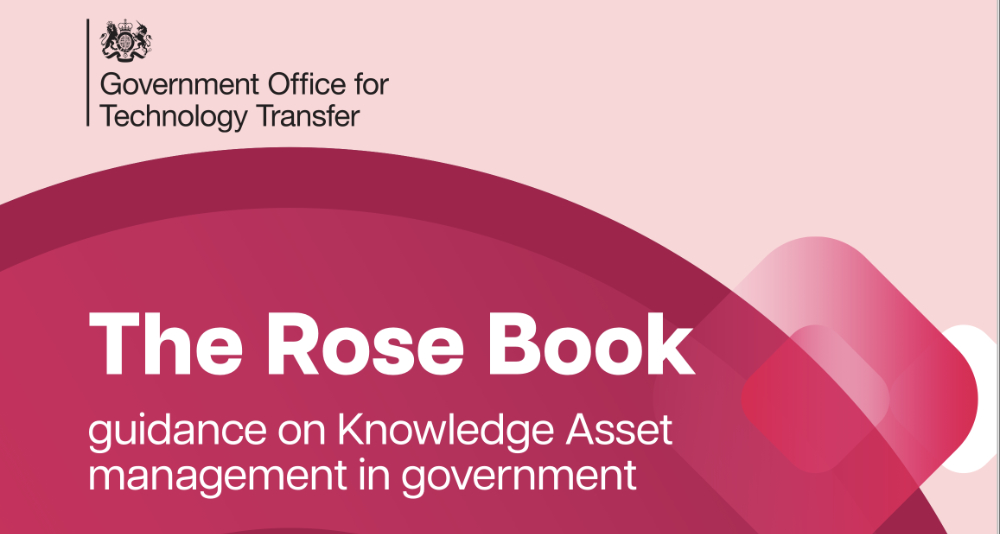
The Rose Book was initially created and published by the UK government in 2021 to advise and support public sector organisations in the management of their Knowledge Assets. The Rose Book provides guidance on the management of knowledge assets such as intellectual property, research and development, and data, in government, with some guidance also applicable to private sector organisations.
The Rose Book was updated in March 2024, the most recent updates made to the document include:
- Improved navigation and accessibility
- Minor updates to existing guidance
- New guidance aimed at those working in HR and procurement
Knowledge Asset Management (KAM) is the approach to identifying, capturing, profiling, classifying, storing, maintaining, protecting, and exploiting knowledge assets of an organisation. Knowledge Assets are valuable assets, critical to the effective delivery of public and private services. It can be important to manage knowledge assets in order to ensure ther value is maximised and not lost or under-utilised.
The UK government Rose Book states that for the public sector, all public sector organisations should have a strategy in place to support the effective management of Knowledge Assets. This will include measures to:
- identify Knowledge Assets
- consider and execute appropriate protection of Knowledge Assets
- support exploitation of Knowledge Assets
Knowledge Assets can have considerable value and impact beyond their original purpose and exploiting this is part of good asset management. This value can be social, economic and financial, and is often a combination of these. Each organisation should consider how best to apply the guidance based on the extent of their Knowledge Asset ownership and should take a proportionate approach. It is recommended that all organisations:
- develop a Knowledge Assets Management Strategy (KAMS), as part of their wider asset management strategy (a requirement of MPM)
- appoint a Senior Responsible Owner (SRO) for Knowledge Assets who has clear responsibility for the organisation’s KAMS
For further information about KAM and KAMS visit The Rose Book: Guidance on Knowledge Asset management in government.
[edit] Related articles on Designing Buildings
- Asset management.
- BIM glossary of terms.
- BIM resources.
- BS ISO 55000:2014 Asset management. Overview, principles and terminology.
- Building information modelling.
- Built asset.
- Concept-knowledge theory.
- Constructed asset.
- Construction knowledge sources.
- Construction knowledge survey.
- Construction knowledge.
- Data.
- Enterprise asset management.
- Fixed asset.
- Indigenous knowledge.
- Knowledge.
- Knowledge asset.
- Knowledge asset management.
- Knowledge based economy.
- Knowledge classification.
- Knowledge gap.
- Knowledge management in construction.
- Knowledge pyramid.
- Knowledge standard.
- Knowledge task group.
- Local knowledge.
- PAS 1192-2.
- PAS 1192-3.
- Real estate.
- Specification for Discoverable Construction Knowledge.
- Stranded assets.
- Tangible v intangible assets.
- Traditional knowledge.
- Types of construction knowledge.
Featured articles
Check out some of the best features and news from Designing Buildings as well as key stories from around the web.

Government approach could undermine delivery and regeneration.
World's first mass timber data centre.

The overlooked environmental aspect of data centre development.
Introduction to radon awareness

New technical information sheet published by CIOB.

Updated supplier guide can help electrical contractors engage with NHP.

CIAT confirm the winners of the 2026 architectural technology awards.

Government launches a one stop shop for flood preparedness.

Sir Edwin Lutyens: Britain's greatest architect? Book review.

CIOB publishes free template to help assess and manage risks.
ECA's reflections on Party Conference season

Burnham wants to be confident of winning before asking for a fresh mandate.
New Chief Construction and Scientific Adviser

Sergio Cavalaro, Professor of Infrastructure Systems at Loughborough University.
Building safety levy for England

CIAT publish estimator tool for members.

Water sector faces a growing crisis that could slow the delivery of vital infrastructure.